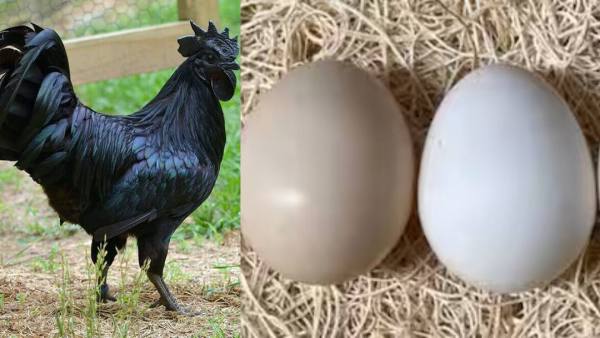
Ayam Cemani is unlike the chicken varieties usually seen in poultry markets. Native to Indonesia, this rare breed is known for its striking black appearance, which goes far beyond its feathers. Its skin, comb, beak, legs, and tongue can also show intense black pigmentation, while the colour extends to its muscles, bones, and internal organs. The unusual feature is linked to a genetic condition called fibromelanosis, which causes excessive melanin pigmentation in the bird’s tissues. Unlike its body, however, the Ayam Cemani does not lay black eggs. Its eggs are generally cream or lightly tinted, making the breed even more intriguing to poultry enthusiasts worldwide.
Why Is Ayam Cemani Completely Black?
The defining feature of Ayam Cemani is its unusually deep pigmentation. The breed carries the fibromelanosis trait, a genetic condition associated with excessive deposition of melanin in different tissues.
As a result, the black colour is not restricted to the feathers. The pigmentation can be seen in the skin, comb, wattles, beak, shanks and tongue. In highly pigmented birds, the colour also extends inside the body, including the muscles, bones and several internal organs. Research has linked the trait to changes involving the EDN3 gene on chromosome 20.
This is also what separates Ayam Cemani from an ordinary black-feathered chicken. A bird may have black plumage without having the same level of pigmentation throughout its body.
Are Ayam Cemani Eggs Really Black?
One of the most common claims about this breed is that it lays black eggs. That is incorrect. Ayam Cemani hens produce cream-coloured or lightly tinted eggs. A 2024 scientific review of the breed notes that the eggs are cream-coloured, with an average weight of around 45 grams. The breed is also not considered a prolific layer, which adds to its value among collectors and specialist breeders.
This limited egg production is important when discussing its price. Unlike commercial laying hens, Ayam Cemani is not bred primarily for large-scale egg production. Its appeal comes from its unusual appearance, rarity, and ornamental value.
The breed is also known to be difficult to reproduce in some populations. Munich’s Hellabrunn Zoo notes that the breed has a relatively small founder population in Europe and that breeding can be challenging, with many eggs failing to hatch.
Why Is Ayam Cemani Considered So Rare?
Ayam Cemani originated in Java, Indonesia, and has long been associated with local traditions and beliefs. Its unusual appearance has contributed to its reputation as a special bird, and it has been linked with traditional rituals and beliefs about mystical properties.
Its rarity has also created a niche market outside Indonesia. Prices can vary substantially depending on factors such as purity of the bloodline, pigmentation, age, breeding quality, and location. Therefore, fixed claims that every Ayam Cemani costs several lakh rupees, or that its eggs routinely sell for thousands of rupees each, should be treated cautiously.
For breeders, maintaining the characteristic pigmentation and a healthy bloodline is more important than simply producing a black-looking chicken. The breed's slower growth and relatively low productivity also make it very different from commercial poultry varieties. A review published in the World's Poultry Science Journal describes Ayam Cemani and other black-meat breeds as slow-growing birds with lower body weights than commercial chickens.
Ayam Cemani is therefore best understood as a rare and distinctive Indonesian breed rather than simply an unusually expensive chicken. Its completely black appearance, unusual genetics, cream-coloured eggs, and cultural history have made it popular among poultry enthusiasts and specialist breeders around the world.
Contact to : xlf550402@gmail.com
Copyright © boyuanhulian 2020 - 2023. All Right Reserved.