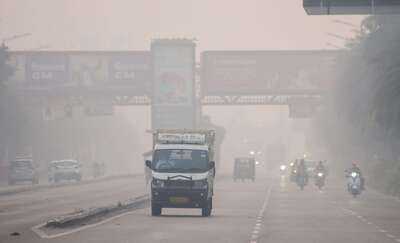
Bathinda : Punjab ’s air quality has deteriorated sharply after Diwali , with the state’s average air quality index (AQI) rising to 235 on Nov 8 and worsening to 287 the next day, as concentrated firecracker emissions, a surge in stubble burning and winter weather combined to trap pollutants.
The AQI remained high at 256 on Nov 10, against 210, 181 and 171 on Nov 8, 9 and 10 last year.
The deterioration was particularly pronounced because Diwali celebrations, unlike last year when they were spread over Oct 20 and 21, were concentrated on Nov 8. The festival also coincided with the peak period for paddy stubble burning and cooler November weather, which favoured thermal inversion and restricted the dispersal of pollutants.
Punjab recorded about 1,198 stubble-burning cases on Diwali alone. Satellite data showed 5,785 active farm-fire incidents between Sept 15 and Nov 13 this Kharif season, higher than 4,734 during the corresponding period in 2025, though lower than 7,621 in 2024. The state recorded 214 farm fires on Nov 13, nearly three times the 72 reported on the same date last year.
The impact was visible across monitoring stations. Mandi Gobindgarh recorded an AQI of 366 on Diwali, against 207 and 297 on the two days of last year’s split celebrations. Amritsar’s AQI stood at 162, compared with 132 on the first day of last year’s festivities.
Punjab Pollution Control Board officials said the timing of Diwali this year coincided with the peak farm-fire period. Farmers typically have 10-15 days between harvesting paddy and sowing wheat, making October and November the busiest months for stubble burning.
Thermal inversion, in which cold, dense air remains trapped beneath warmer air, further restricted the dispersal of PM2.5 and PM10 pollutants, allowing firecracker smoke and farm-fire emissions to accumulate near the ground and prolong the smog.
Delhi, meanwhile, recorded an average AQI of 376 on Nov 8 and 344 on Nov 9. Its air quality remained in the very poor to severe categories during early November, peaking at 382 on Nov 6.
The pollution spike also triggered a political exchange. BJP leaders blamed the increase in Punjab’s farm fires for Delhi’s smog, while AAP representatives accused the BJP of scapegoating Punjab’s farmers, citing vehicular emissions, geographical constraints and local dust as other contributors to Delhi’s pollution.
Contact to : xlf550402@gmail.com
Copyright © boyuanhulian 2020 - 2023. All Right Reserved.