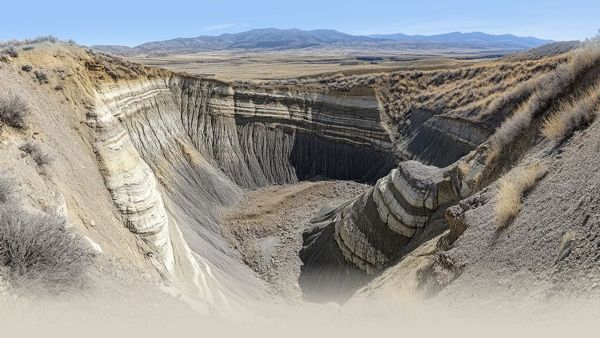
Baghdad: Iraq is drowning in the ground or accurately, the area around the Agros Mountains in the north of the country is sinking into the earth, a team of researchers has found that the sinking below the surface of the earth to the northern region of the sea slab Iraq Pulling down with you. There is no talk of any synchole here, where you can see the hills, trees and entire part of the ground disappearing in front of your eyes.
According to the currently geologist Renas Koshnav at the Massachusetts Institute of Technology (MIT), geological processes in this case are very slow, which are beyond the scale of human time. According to Koshanay, 'The effect of these processes cannot be felt immediately. We are talking about millions of years. This is happening due to the sliding of the tectonics plate. A region cracks with Arabia and Eurasian continental plates are forming, known as Neotethis ocean slabs. This slab used to be the bottom of an ancient ocean more than 66 million years ago.
Slab drowning in the mental of the earth
Now this slab is divided from southeast Türkiye to northwest Iran. In the language of geology, now the slab is drowning in the mental of the earth. Koshnav said, “This process is complex and it takes millions of years.” Today's mountain ranges like Jagros are the result of these tectonic conflicts. Seeing the deep earth imaging -backed rock record and sediment, researchers found that Neotethis slab was sinking and taking the Jagros region of Iraq with them.
Research will help in predicting earthquake
These evils have many practical implications because they reveal the mechanisms by which this is our governing. This study highlighted how dynamic this is our internal and outer part. Its results can be used to make more accurate geological models, which reflect deep activity below the Earth's surface. These models can help in predicting earthquakes.
Click on this link to read other abroad news…
Koshnav said, 'Earthquakes arise from the fractures of layers of the rocks or the location changes with their slipping. This process can be on any depth or scale. To explain where, at what depth and on which scale, scientists need to understand the geological configuration and geometry of the rock on a large scale. '