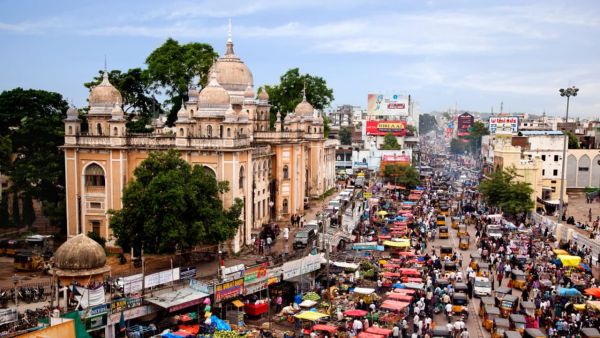
A full-time Rapido/Uber rider in Hyderabad, covering 120-150 km daily, says the city’s traffic crisis results from many large cars carrying one person, easy car EMIs, narrow old roads and weak public transport system.
A Rapido/Uber rider who travels 120-150 km every day in Hyderabad has posted a clear and simple diagnosis of the city's traffic problems. He says the main cause is not the number of people. It is the number of large vehicles carrying too few people. He sees things that drivers in cars often do not notice.

The roads in Hyderabad are old and narrow. They were not built for today's vehicle load. Building more flyovers will not fix local choke points. The rider says the same blockages keep appearing because the main roads themselves cannot handle so many big vehicles.
'Cars are too big and too easy to buy'
The rider points out that many cars on the road are large SUVs or sedans with only one or two people inside. A single big car takes up the space that four or five bikes could use. From a bike seat you see these big gaps being closed by oversized vehicles every minute. This slows traffic a lot.
Easy car EMIs are a big reason for this change. Banks now offer long loans with small down payments. People buy cars on EMI like they buy mobile phones. This encourages buyers to choose expensive SUVs that they do not need. Many buyers cannot truly afford fuel and maintenance but still buy cars because the monthly payment seems small.
If even 20 percent of bikers buy cars, the rider warns, Hyderabad's traffic will collapse. For now, the many two-wheelers keep the city moving.
Public transport is not solving the problem
Public transport does not help much, the rider says. The metro is useful but it does not reach most places where people live or work. Buses are slow and unreliable. Auto rickshaws charge high fares when they want. Without reliable public transport, people fall back on private vehicles. Private vehicles then multiply because buying a car is so easy.
A commenter on his post agrees that the solution is not more lanes. Instead, the city needs better public transport, more walkable footpaths and less car-centric design. If buses and metros reached more places, people might prefer them over private cars.
Pollution and poor regulation add to the problem
Another comment draws attention to pollution from autos. Some autos use poor fuel to save money and leave black smoke. The rider says he wears a mask while riding because the air is often so bad he can taste the pollution. This is a public health issue as well as a traffic problem.
A commenter also noted a pattern across sectors. When public services are weakened, private firms fill the gap. The telecom example was mentioned: when public providers were pushed out, private companies grew. The same pattern applies to transport. Reduced public transport encourages private vehicle sales, which benefits vehicle manufacturers.
Work concentration and city planning make traffic worse
Comments on the Reddit user's post also highlight another cause: job concentration. Many private jobs are concentrated in the west of Hyderabad in tech and finance districts. New offices keep opening in the same areas. This leads to uneven travel patterns and heavy flow on certain roads. Corporates that create large offices should not get incentives that push work to a few parts of the city, one comment says.
High-rise development also affects roads. New housing with many flats adds many users to the same road space. A reader wrote that roads and population density must be proportional. If roads are small and many people live nearby in high rises, traffic will gridlock. The suggestion was simple: build better public transport and more walkable spaces.
Not all blame rests with car owners. One comment points out that many two-wheeler riders drive recklessly. They change lanes quickly, overtake on the left and sometimes use the wrong side of the road. These behaviours also add to inefficient traffic movement and danger on the roads.
Readers reacted to the rider's clear writing and skills. One asked why he rides Rapido/Uber if he could do other work. The rider replied that he is building skills and using this phase to stay afloat. He aims to take home about Rs 1,000 after commission and fuel, which requires riding 120-150 km.
Another reader recalled meeting an Uber driver with excellent English who chose ride work over a 9 to 5 job. The comment shows that many people choose gig work for different reasons: some are waiting for a chance, others prefer flexibility.
A likely future unless policy changes
The rider says current peak-hour speeds are low. It can take 35-40 minutes to travel 10 km during peak hours now. Five years ago this was not normal. If nothing changes, Hyderabad risks heading towards a Bangalore-style traffic collapse, with wider roads and worse discipline.
The rider urges the city to stop treating flyovers as the main solution. He calls for strong investment in public transport, better bus services, metro expansion, walkable footpaths and sensible rules about where large offices can set up. He also suggests the city balance roads with planned housing so density does not overwhelm the infrastructure.
What people want: practical fixes
Commenters offered practical ideas:
- Improve and expand bus services to be reliable and fast.
- Extend the metro network to more residential and work areas.
- Build safer, walkable footpaths and cycle lanes.
- Avoid car-centric planning and reduce incentives that favour office clustering.
- Encourage shared rides and higher vehicle occupancy.
- Enforce cleaner fuels and stricter rules for autos to limit pollution.
One comment read as: "I would be willing to pay Rs 7,000-8,000 a month for an AC bus that made travel easy and safe." That shows demand for quality public transport exists.
A rider's warning and a city's choice
A full-time rider who knows the city from ground level drew a simple conclusion: the problem is not too many people, but too many big vehicles carrying too few people in a city that was never built for them. Hyderabad can avoid worse gridlock if it acts now. The choice is clear: fix public transport, rethink road use and limit car growth driven by easy EMIs or face much longer journeys and more pollution in the years ahead.
Contact to : xlf550402@gmail.com
Copyright © boyuanhulian 2020 - 2023. All Right Reserved.