
New Delhi: The Confederation of Indian Industry (CII) has said that the rooftops of office towers, hospitals and residential complexes could serve as landing and take-off points for electric air taxis, offering an additional source of revenue generation.
In a report titled 'Navigating the Future of Advanced Air Mobility in India', the industry body has proposed a pilot electric vertical take-off and landing (eVTOL) corridor linking Gurugram, Connaught Place and the upcoming Jewar International Airport, a move that could cut travel time across the National Capital Region (NCR).
Released on Friday by civil aviation minister Rammohan Naidu Kinjarapu, the report positions advanced air mobility (AAM) as a high-impact solution to urban congestion while aligning with India's net zero 2070 commitments through zero-emission aircraft.
The proposed NCR corridor is envisioned as a scalable regulatory sandbox that could help India build a domestic "Make in India" ecosystem for next-generation aerospace technologies. The report says lessons from pilot could be replicated across high-density economic clusters.
A key recommendation is the creation of a dedicated AAM regulatory function within the Directorate General of Civil Aviation (DGCA) to frame airworthiness, operational and safety standards for low-altitude urban flights. The report outlines a phased roadmap for integrating eVTOLs into Indian airspace, beginning with drone-based logistics and medical supply deliveries over short ranges. Rooftop vertiports, the study notes, offer a practical alternative to ground-based facilities, creation of which are often stalled by land acquisition hurdles and regulatory delays.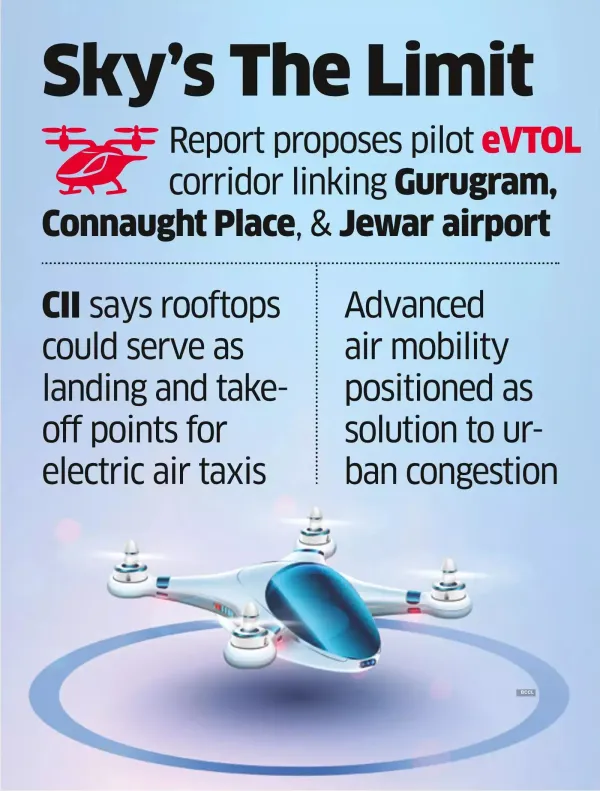
While DGCA norms do not permit routine commercial rooftop operations, the report suggests that evolving safety frameworks could unlock their potential, especially in dense urban cores.
The study calls for early collaboration with urban planners and smart city missions to embed AAM corridors and charging infra into city master plans. Public financial institutions, including SIDBI and banks, are urged to create dedicated funding instruments to de-risk investments in the sector, it says.
In a report titled 'Navigating the Future of Advanced Air Mobility in India', the industry body has proposed a pilot electric vertical take-off and landing (eVTOL) corridor linking Gurugram, Connaught Place and the upcoming Jewar International Airport, a move that could cut travel time across the National Capital Region (NCR).
Released on Friday by civil aviation minister Rammohan Naidu Kinjarapu, the report positions advanced air mobility (AAM) as a high-impact solution to urban congestion while aligning with India's net zero 2070 commitments through zero-emission aircraft.
The proposed NCR corridor is envisioned as a scalable regulatory sandbox that could help India build a domestic "Make in India" ecosystem for next-generation aerospace technologies. The report says lessons from pilot could be replicated across high-density economic clusters.
A key recommendation is the creation of a dedicated AAM regulatory function within the Directorate General of Civil Aviation (DGCA) to frame airworthiness, operational and safety standards for low-altitude urban flights. The report outlines a phased roadmap for integrating eVTOLs into Indian airspace, beginning with drone-based logistics and medical supply deliveries over short ranges. Rooftop vertiports, the study notes, offer a practical alternative to ground-based facilities, creation of which are often stalled by land acquisition hurdles and regulatory delays.
These idle spaces could unlock additional income, says CII study
While DGCA norms do not permit routine commercial rooftop operations, the report suggests that evolving safety frameworks could unlock their potential, especially in dense urban cores.
The study calls for early collaboration with urban planners and smart city missions to embed AAM corridors and charging infra into city master plans. Public financial institutions, including SIDBI and banks, are urged to create dedicated funding instruments to de-risk investments in the sector, it says.