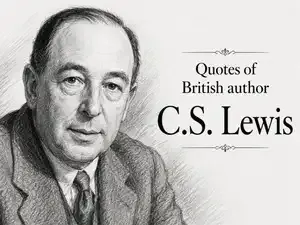
Quote of the Day: C.S. Lewis was a renowned British author, scholar, and Christian thinker born in Belfast in 1898. The Irish-born scholar, novelist, and author, who wrote about 40 books, initially struggled with questions of faith and spirituality before later embracing Christianity, an experience that deeply shaped his writing and philosophy. Lewis taught at both Oxford and Cambridge universities and became one of the most influential literary and religious voices of the 20th century.
Lewis is best known for writing The Chronicles of Narnia, one of the most beloved fantasy series in modern literature. He also gained widespread recognition for his Christian apologetic works, including Mere Christianity and The Screwtape Letters. Through both fiction and non-fiction, Lewis explored morality, faith, temptation, and the nature of good and evil in ways that continue to resonate with readers worldwide.
Quote by British author C.S. Lewis: ‘There is no uncreated being except God. God has no opposite’
C.S. Lewis Quote: Meaning, Context and Interpretation
Lewis often wrote about the dangers of misunderstanding evil as a power equal to God. In Christian theology, evil is not viewed as an independent force that rivals God, but rather as a corruption or absence of good. His writings frequently emphasized that all created beings, including those who choose evil, ultimately exist within the order of creation.
The quote suggests that God alone is eternal and uncreated, while every other being or force is part of creation. By saying “God has no opposite,” Lewis argues that evil does not stand on the same level as divine power. The statement encourages readers to see goodness, truth, and love as fundamentally stronger and more enduring than darkness or corruption.
Evil and negativity should never be viewed as equal in power to goodness and truth, as fear often grows when people give darkness more strength than it truly possesses. In times of uncertainty and hardship, faith and moral conviction can provide resilience and inner strength, while true wisdom comes from understanding the deeper distinction between creation, corruption, and genuine goodness.
ALSO READ: Quote of the day by Helen Keller: 'The only thing worse than being blind is having sight but...' - American author's timeless wisdom on life's purpose and direction
Lewis is best known for writing The Chronicles of Narnia, one of the most beloved fantasy series in modern literature. He also gained widespread recognition for his Christian apologetic works, including Mere Christianity and The Screwtape Letters. Through both fiction and non-fiction, Lewis explored morality, faith, temptation, and the nature of good and evil in ways that continue to resonate with readers worldwide.
Quote by British author C.S. Lewis: ‘There is no uncreated being except God. God has no opposite’
C.S. Lewis Quote: Meaning, Context and Interpretation
Lewis often wrote about the dangers of misunderstanding evil as a power equal to God. In Christian theology, evil is not viewed as an independent force that rivals God, but rather as a corruption or absence of good. His writings frequently emphasized that all created beings, including those who choose evil, ultimately exist within the order of creation.
The quote suggests that God alone is eternal and uncreated, while every other being or force is part of creation. By saying “God has no opposite,” Lewis argues that evil does not stand on the same level as divine power. The statement encourages readers to see goodness, truth, and love as fundamentally stronger and more enduring than darkness or corruption.
Evil and negativity should never be viewed as equal in power to goodness and truth, as fear often grows when people give darkness more strength than it truly possesses. In times of uncertainty and hardship, faith and moral conviction can provide resilience and inner strength, while true wisdom comes from understanding the deeper distinction between creation, corruption, and genuine goodness.
ALSO READ: Quote of the day by Helen Keller: 'The only thing worse than being blind is having sight but...' - American author's timeless wisdom on life's purpose and direction