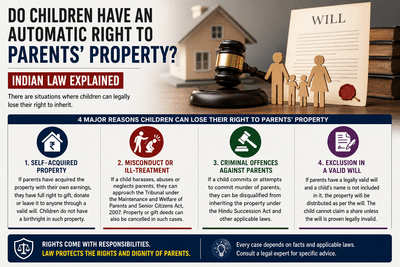
Many people believe that children automatically have a lifelong legal right to their parents' property. However, the legal position in India depends on the nature of the property, the existence of a valid will, and other provisions under succession and senior citizen protection laws.
Legal experts point out that ownership rights are not always absolute, especially when the property is self-acquired. In certain circumstances, children may not receive any share in their parents' assets or may lose the ability to claim them.
Here's a closer look at the situations where property rights may differ under Indian law.
Self-Acquired Property and Ancestral Property Are DifferentOne of the most important distinctions under Indian property law is the difference between self-acquired property and ancestral property.
Self-Acquired PropertyProperty purchased or acquired by parents using their own income or resources is generally considered self-acquired property.
In such cases, the owner has broad legal authority to decide how the property will be transferred. Subject to applicable personal laws and legal requirements, they may:
- Gift it to another person.
- Transfer it to a trust.
- Leave it to any beneficiary through a valid will.
- Exclude one or more children from inheritance through a legally valid testamentary arrangement.
Because the property belongs exclusively to the owner, children generally do not acquire an automatic ownership right during the parent's lifetime.
Ancestral PropertyRules governing ancestral property are different and depend on the applicable succession laws. Rights in ancestral property may arise by birth under certain legal frameworks, and disputes involving such property often require judicial determination based on the facts of each case.
Can Misconduct Affect Property Rights?Indian law also provides legal remedies to protect senior citizens from neglect or abuse.
Under the Maintenance and Welfare of Parents and Senior Citizens Act, 2007, parents who face neglect, abuse, or ill-treatment may seek relief before the appropriate authority.
In certain circumstances permitted under law, transfers or gifts made to children may also be challenged if they were subject to conditions regarding care and maintenance that were subsequently violated.
Each case is decided on its own facts and applicable legal provisions.
What Happens If a Child Commits a Serious Crime Against a Parent?Succession laws also contain provisions relating to serious criminal conduct.
A person convicted in connection with the unlawful killing of the individual from whom they seek to inherit may be disqualified from inheriting that person's estate under the applicable legal principles.
Courts decide such matters based on criminal convictions and the relevant succession laws in force.
Importance of a Valid WillA legally executed will plays a crucial role in determining how self-acquired property is distributed after the owner's death.
If a valid will clearly specifies the beneficiaries, the property is generally distributed according to the wishes expressed in that document.
A person seeking to challenge a will must establish legally recognized grounds, such as lack of testamentary capacity, undue influence, fraud, coercion, or other defects recognized by law. Mere dissatisfaction with the distribution is generally not sufficient.
Rights Come with ResponsibilitiesLegal experts often emphasize that inheritance disputes involve both legal rights and family responsibilities.
Parents are entitled to seek legal protection if they experience neglect, harassment, or abuse. Likewise, children should understand that inheritance laws vary depending on:
- The nature of the property.
- The existence of a valid will.
- Applicable succession laws.
- Court orders, where relevant.
Because every family situation is different, property disputes frequently require legal interpretation based on individual facts.
Final TakeChildren do not automatically enjoy identical rights over every type of parental property. While ancestral and self-acquired assets are treated differently under Indian law, parents generally retain significant control over their self-acquired property, including the right to distribute it through a valid will. In addition, legal provisions protecting senior citizens and succession laws may affect inheritance rights in specific situations. Anyone involved in a property dispute should seek qualified legal advice based on the facts of their individual case and the applicable personal and succession laws.
Contact to : xlf550402@gmail.com
Copyright © boyuanhulian 2020 - 2023. All Right Reserved.