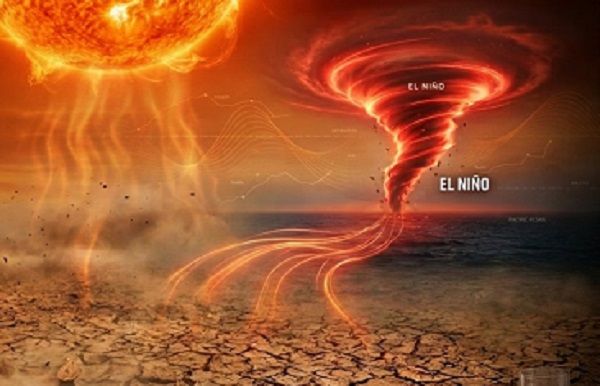
The world may have to face another scorching heat in the coming years. According to meteorologists, El Niño developing in the Pacific Ocean may be unusually strong. If current forecasts prove correct, it could become one of the most powerful El Niño events recorded since the 19th century.
It is expected to have a direct impact on global temperature. According to scientists, 2026 or 2027 may be ahead in the race to become the world's hottest year.
Read this also The most severe El Nino of the century will happen in 2027….. Predictions of meteorologists increase concern
What is El Niño and why is there increased concern?
El Niño is a natural climate phenomenon in which marine waters in the central and eastern Pacific Ocean become much warmer than normal. Due to the warming of the ocean, additional heat reaches the atmosphere and the normal patterns of wind, rain and temperature start changing.
This time the sea surface temperature in the eastern Pacific region is expected to be about 3 degrees Celsius higher than normal. This increase is typically considered to be around 1 to 2 degrees Celsius during a strong El Niño.
How strong can El Niño be this time?
According to scientists, even if the sea surface temperature goes 2 degrees Celsius above normal, it is still considered a very strong El Niño. In such a situation, a possible increase of about 3 degrees has increased the concern.
Earlier extremely strong El Niños were recorded in 1982–83, 1997–98 and 2015–16. According to British Meteorological Department scientist Adam Scaife, such a strong El Niño signal has never been seen in his forecasts before.
India's monsoon may also be affected
The impact of El Niño is not uniform across the world. At some places this may lead to excessive rains and floods, at other places the risk of drought and extreme heat may increase.
The biggest concern for India is regarding monsoon. Strong El Niño is often linked to weak monsoon conditions in India. However, its effect is not the same every time, hence the initial forecasts of monsoon will also be monitored.
If El Niño remains strong for a long time, its impact on rainfall distribution, agriculture and temperature in India may be seen.
2026 or 2027 could become the hottest year
Scientists predict that a strong El Niño could cause another spike in global average temperatures. 2026 has the potential to become the hottest year, but the risk for 2027 is no less.
One reason for this is that the full effect of the additional heat accumulated in the ocean during El Niño may not be visible immediately on the Earth's average temperature, but after some time.
Climate change increases the challenge
Global temperature records were broken during strong El Niño in years such as 1998 and 2016. But the current situation is different from before. Due to climate change, the Earth's average temperature has already increased significantly compared to historical levels.
In such a situation, if a powerful El Niño develops, it can further heat the already heated earth. Scientists estimate that global temperatures could remain more than 1.5 degrees Celsius above pre-industrial levels for some time in 2027.
That is, in the coming months, the world is keeping an eye on El Niño because it can become an event not only to the change in ocean temperature, but also to new records of heat, rain, monsoon and global climate.
Contact to : xlf550402@gmail.com
Copyright © boyuanhulian 2020 - 2023. All Right Reserved.