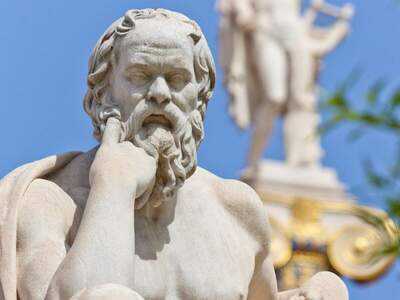
More than 2,000 years separate from the parents and teachers of today. But judging by one famous complaint attributed to the , some frustrations have apparently been around for a very long time. One such complaint seems to have been captured by Socrates in his that goes, “Children nowadays are tyrants. They contradict their parents, gobble their food, and tyrannise their teachers.”
The quote, which can be found on Goodreads, sounds surprisingly modern. Children talking back to their parents, forgetting their manners and testing the patience of teachers would hardly be an unfamiliar description today. Yet the line has long been associated with Socrates, who lived in Athens in the fifth century B.C.
What Socrates' quote of the day says about children
“Children nowadays are tyrants. They contradict their parents, gobble their food, and tyrannise their teachers.”
The children mentioned in the quote are not merely mischievous. They are presented as disrespectful and unruly, unwilling to accept the authority of either parents or teachers.
Even the choice of the word “tyrants” makes the complaint unusually dramatic. Instead of adults exercising authority over children, the line turns that relationship on its head: the children appear to be running the show.
Perhaps that is also what has helped the saying survive. Complaints about badly behaved children are certainly not confined to ancient Greece. Versions of the same argument appear whenever an older generation begins wondering what has gone wrong with the younger one.
The irony becomes even more interesting in Socrates' case. Here was a philosopher remembered for questioning received wisdom and refusing to accept claims simply because someone in authority made them. Yet in this quote, children challenging authority are presented as part of the problem.
But before reading too much into that contradiction, there is good reason to be careful about the attribution itself.
Did Socrates actually say it?
Socrates left no books, essays or written record of his teachings.
Most of what survives about his life and thought comes through other people. Plato, his most famous student, made Socrates a central figure in his dialogues. Xenophon also wrote about him. Aristophanes, meanwhile, famously turned him into a comic character in The Clouds.
This makes quotations attributed to Socrates particularly tricky. Goodreads carries the “children nowadays are tyrants” line under his name, but its appearance there does not tell us where or when he supposedly said it.
Without an original work by Socrates to consult, popular quotations carrying his name cannot automatically be treated as his recorded words.
The uncertainty does not make the sentiment any less interesting. In some ways, it makes the quote more interesting because of how readily people have accepted it as something an ancient Greek might have said.
Socrates' philosophy of asking uncomfortable questions
Socrates is remembered above all for asking questions, often enough to expose problems in answers that initially sounded convincing.
The approach associated with him became known as the Socratic method. Rather than simply telling someone that an argument was wrong, Socrates would keep questioning its assumptions. An answer could lead to another question, which could uncover a contradiction and force the discussion in a new direction.
Plato's Euthyphro offers a classic example. The dialogue begins with a discussion about piety, but attempts to define exactly what makes an action pious repeatedly run into difficulties under Socrates' questioning.
That pattern appears throughout accounts of his philosophy. Certainty was something to be examined, not simply admired.
It is also behind one of the ideas most closely associated with Socrates: wisdom begins with recognising the limits of one's own knowledge.
A famous story involving the Oracle at Delphi illustrates the point. The oracle reportedly declared that no one was wiser than Socrates. Socrates, puzzled by the claim, set about questioning people who were considered wise. What he found, according to Plato's Apology, was that people could be confident in knowledge they did not actually possess.
His advantage, as he came to understand it, was not that he knew everything. It was that he did not pretend to know what he did not know.
Why a complaint about children survives
Strip away Socrates' name and the line could belong to almost any period.
Every generation grows up under the criticism of the one before it. Children are said to be less respectful. Students are harder to teach. Manners are disappearing. Discipline is not what it used to be.
That recurring anxiety is what gives the quote its punch today. Its appeal depends less on ancient than on the recognition that adults have a habit of looking at the generation coming after them and wondering whether something has changed for the worse.
In Socrates' own life, questions about young people became far more serious than complaints about table manners or troublesome students.
In 399 B.C., he was put on trial in Athens on charges that included impiety and corrupting the youth. He was convicted and sentenced to death.
Plato later described Socrates refusing an opportunity to escape. Instead, he accepted the judgment of the city and eventually drank hemlock.
It was an extraordinary end for a man whose legacy would become inseparable from questioning assumptions.
That legacy also gives the supposed quote about unruly children an odd afterlife. We cannot confidently treat the line as Socrates' own words, but people continue to recognise themselves in it.
More than two millennia may have passed, but apparently the suspicion that “children nowadays” are getting out of hand never really went away.
Contact to : xlf550402@gmail.com
Copyright © boyuanhulian 2020 - 2023. All Right Reserved.