
The ministry of information and broadcasting is also keen to introduce competition into a market dominated by BARC.
Mumbai: The delay in renewing the registration of the Broadcast Audience Research Council (BARC) India has exposed divisions over broadcaster influence, audience measurement and competition in India's television ratings market, while a prolonged ratings blackout is putting pressure on broadcasters and distribution platforms.
The ministry of information and broadcasting (MIB) is yet to decide on fresh registration applications from BARC and TAM India, a joint venture between Nielsen and Kantar Media. Key concerns include BARC's ownership structure, progress on cross-media measurement and the absence of an updated Broadcast India study, according to people familiar with the matter. The ministry is also keen to introduce competition into a market dominated by BARC.
Also Read: JioHotstar collaborates with DGO, launches streaming service in Nepal
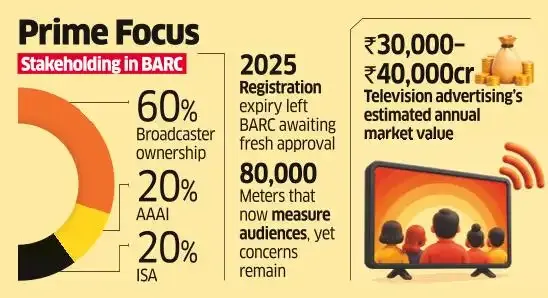
At the centre of the dispute is BARC's ownership. The Indian Broadcasting and Digital Foundation (IBDF) holds a 60% stake, while the Advertising Agencies Association of India (AAAI) and the Indian Society of Advertisers (ISA) own 20% each.
 "While the MIB has stated that BARC needs to comply with the TV Ratings Guidelines 2026 to get fresh registration, one of the key concerns of the MIB has been the stranglehold of broadcasters on BARC," said a person familiar with the government's thinking.
BARC's previous registration expired in 2025. It has since appointed new independent directors and expanded its measurement panel to nearly 80,000 meters, but the ministry reportedly remains dissatisfied with its progress on cross-media measurement and the lack of an updated Broadcast India study, which underpins its measurement framework.
Also Read: South film producers in thrall to streaming deals
The MIB stopped BARC from publishing audience measurement data in June, while news viewership data has been withheld since March. An informal group of ministers is understood to be examining the issue.
The blackout has deprived broadcasters of a key benchmark for evaluating channel performance and demonstrating advertising value. India's television advertising market is estimated at Rs 30,000 crore to Rs 40,000 crore.
"Entertainment broadcasters are paying the price of divisions in the news industry," a regulatory official said, noting that news accounts for a smaller share of the market than entertainment.
The suspension has also raised questions about BARC's finances. While Crisil said in a bulletin published in late August that BARC's operations remained unaffected despite the suspension, citing continued cash inflows from broadcasters, healthy liquidity and minimal debt.
A broadcasting industry official claimed that most broadcasters had stopped paying the ratings body. "Barring two broadcasters, other broadcasters are not paying BARC, which means that BARC is on the brink of a collapse," the official said.
A prolonged impasse could threaten smaller and free-to-air channels, while affecting advertising sales, production and marketing jobs. It could also hit revenues at DD Free Dish and distribution platforms such as Hathway and Siti Networks.
The ministry of information and broadcasting (MIB) is yet to decide on fresh registration applications from BARC and TAM India, a joint venture between Nielsen and Kantar Media. Key concerns include BARC's ownership structure, progress on cross-media measurement and the absence of an updated Broadcast India study, according to people familiar with the matter. The ministry is also keen to introduce competition into a market dominated by BARC.
Also Read: JioHotstar collaborates with DGO, launches streaming service in Nepal
At the centre of the dispute is BARC's ownership. The Indian Broadcasting and Digital Foundation (IBDF) holds a 60% stake, while the Advertising Agencies Association of India (AAAI) and the Indian Society of Advertisers (ISA) own 20% each.
BARC's previous registration expired in 2025. It has since appointed new independent directors and expanded its measurement panel to nearly 80,000 meters, but the ministry reportedly remains dissatisfied with its progress on cross-media measurement and the lack of an updated Broadcast India study, which underpins its measurement framework.
Also Read: South film producers in thrall to streaming deals
The MIB stopped BARC from publishing audience measurement data in June, while news viewership data has been withheld since March. An informal group of ministers is understood to be examining the issue.
The blackout has deprived broadcasters of a key benchmark for evaluating channel performance and demonstrating advertising value. India's television advertising market is estimated at Rs 30,000 crore to Rs 40,000 crore.
"Entertainment broadcasters are paying the price of divisions in the news industry," a regulatory official said, noting that news accounts for a smaller share of the market than entertainment.
The suspension has also raised questions about BARC's finances. While Crisil said in a bulletin published in late August that BARC's operations remained unaffected despite the suspension, citing continued cash inflows from broadcasters, healthy liquidity and minimal debt.
A broadcasting industry official claimed that most broadcasters had stopped paying the ratings body. "Barring two broadcasters, other broadcasters are not paying BARC, which means that BARC is on the brink of a collapse," the official said.
A prolonged impasse could threaten smaller and free-to-air channels, while affecting advertising sales, production and marketing jobs. It could also hit revenues at DD Free Dish and distribution platforms such as Hathway and Siti Networks.